Airstream Restoration of Scott and Kathy's 1955 Flying Cloud Whale Tail - Our California Vintage Airstream.
Showing posts with label Fresh Water Tank. Show all posts

Friday, February 7, 2014

Past Post Upgrade - Strapping Tanks


Colin Hyde provided more information which I've used to update the 1/25/2014 post Strapping Tanks.

Saturday, February 1, 2014

Warming Up - Insulating the Belly Pan

Reflectix reflective insulation is cut to fit under the plywood floor between the frame rails including above the water tanks.   It will also be used to insulate under the water tanks.
Note:  The step is painted with a UV resistant topcoat over the black POR 15.
The visible portions of the rails will topcoat painted soon. 

The portions of the frame that are cut out for the plumbing connections - all will be strong!  Each cross member will be strengthened at the bottom with a heavy steel bolt-on bridge.  The bolts will allow access to the plumbing if needed at a later date.


The dump valve is installed & valve handles extended through the main rail into an are that will be accessible through a flip down hatch.


 Gray tanks installed!


Fiberglass Insulation to really keep us warm! 

The end of the cross members have the added anti-chaffing strips.
First piece of the belly pan is cut!!!!  We are moving forward again!

Friday, January 31, 2014

Adding Grey Tanks - First in 58 Years! Part 2

At Colin Hyde Trailer Restorations, Reid has been working on our plumbing - thanks Reid!

The bathroom lavatory sink and shower join to drain down to the first (forward) tandem grey tan.
 First checking the fit of all parts before they are attached/glued together permanently


Adding gray tanks to our vintage Airstream for the first time in 58 years! 
During travel, trailers move and flex.  While it is not legal or safe to ride in a moving trailer, someday I'd like to get a video set up to see the movement that happens.  The movement can break areas that are too stiff.  To be sure that our tandem tanks maintain a secure and dry connection, a flexible link is added between grey the two tanks.  Thick rigid foam insulation is added to further protect the link and will keep the tanks from shifting forward and backward within the frame.  A similar link will be added to the tandem fresh water tanks.


From the back of the rear grey tank, the used water will exit the trailer through the combination black and gray water valve.  Unlike modern trailers, the dump valve will not hang below the belly pan.  I just realized I have very few photos showing our dump valve - just not photogenic!   Because in 1955 we had no dump valve, our Flying Cloud valve handle will not show on the exterior of the trailer. The valve handle will be accessible through a hatch in the belly pan.  This decision will also keep our restoration with the beautiful clean design of 1955.


Both the fresh & grey water tanks with plumbing connections.
  
The portions of the frame that are cut out for the plumbing connections - all will be strong!  Each cross member will be strengthened at the bottom with a heavy steel bolt-on bridge.  The bolts will allow access to the plumbing if needed at a later date.


The shower pan's drain trap will fit inside the frame, hidden by the belly pan.


Thursday, January 30, 2014

Double Draining - Planning the Bathroom Drains

We don't use a lot of water in our 2008 Airstream, we can go without a fresh water fill up for at least 5 days.  And I expect that our water use will remain the same for our 1955 vintage Airstream.
We do need a larger water tank than the missing original fresh tank that fit under the cabinet under the front window.

We are taking advantage of Vintage Trailer Supply's standardized water tanks, positioning the two tanks below the floor in between the frame rails.  Plumbing the fresh tanks in tandem will work really well for us.  The tandem gray tanks will hold the same amount of water, reducing the possibility of overflow which I really want to avoid!

Putting the tanks into their spots in the frame rails.


Close-up of the tank straps covered with a peel-and-stick waterproof membrane.


The street-side plumbing is for the bathroom lavatory sink and the shower drains.  They join together to drain into the new grey tanks.  Back in 1955 Airstream and other trailers did not have holding tanks for water coming from the sinks and shower, and water was just dumped on the ground.  Not very sanitary, and so I'm glad to upgrade our Flying Cloud.


 Cutting the cross members for the tandem tank fittings.


The cross members ready for the tank connector. Note: the step was painted with the gray topcoat over the POR15 rustproof paint.

Saturday, January 25, 2014

Strapping Tanks

Below the floor, will be two gray water tanks, and also 2 fresh water tanks.  These are standard 16 gallon tanks, now available at Vintage Trailer Supply - saves lots of money!  The metal straps, fabricated by Colin Hyde,  will keep the tanks secured in between the main rails.


UPDATE 2/6/2014 -  Colin Hyde's reply to Gary's question.

I have a 55 Flying Cloud also. I'm in the process of installing the water tanks now. Why do the straps have a loop in them? They don't have a "loop" in them. They are formed like a "C" with short legs on either end. This allows us to install the bolts longitudinally instead of vertically, causing protrusions in the bellypan. It also allows us to put tension on the straps.  How are they secured on the topside (is it just pressure against the bottom of the floor)? The tanks are up against the underside of the floor & foam blocks minimize lateral movement. 
Coli

Monday, October 1, 2012

Frame was 3" - Now 4" Deep - Or is it???

Prior to 1955 Vintage Airstream Frames were 3" deep.
The change to a stronger 4" frame was started in 1955.
Unfortunately, our Flying Cloud was manufactured in California with the 3" frame.  Our gray water and fresh water tanks from Vintage Trailer Supply are 4" deep.  As planned - to fit the tanks into the frame, Colin Hyde changed our frame to be 4" deep.

The longer frame will allow us to add a bumper trunk also.
With the small angle cut from the frame, the 3" bumper remains the original depth!
Welded closed, this also prevents water from sitting inside the frame causing rust.
And eliminates a way for mice and other critters to enter the trailer.

In 1955 and many other years, Airstream built trailers with  no rear cross member.  So the plywood floor was not directly supported by the frame, rather the floor was cantilevered from the next forward cross member.  And the plywood was originally attached through the C-Channel only to the aluminum shell.  
No wonder that attaching accessories to the back of an Airstream is a bad idea.  Spare tires, generators, even bike racks should not be attached to the trailer rear without significant frame work.
Colin beefed up our structure by adding a rear cross-member.  The aluminum shell, plywood floor, C-Channel, and shell will all be securely attached together with elevator bolts.


Rotisserie!
The front hold-down plate was removed, but will be replaced.  The hold down plate strengthens the connection of the frame to shell at the higher stress front area.

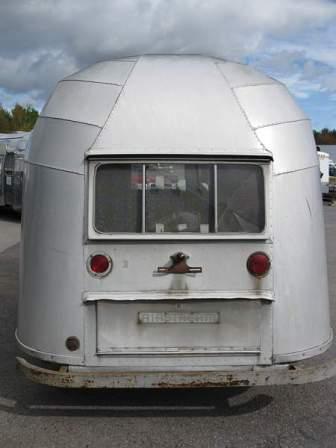

Saturday, June 2, 2012

Changing the Frame to Fit the Tanks

Above is a photo before the frame change.
The frame is structurally sound, so only surface rust was removed.
The missing outrigger will be fabricated and welded back to the frame.
The frame is cut to make room for the in-frame fresh water tank.
A new front cross rail and out rigger are welded back to the frame.
Here the frame is upside down showing the new A-frame connection to the cross rail.

Monday, January 18, 2010

Peeping Tom

Peeping into our walls - this is our first look - photos sent by Colin from Plattsburgh NY.


We expected water damage in the toilet room. And under the front jalousie window / water tank.

And as always the back floor. I need to ask Colin why the metal at the base is not one solid piece...
 
As usual my question has been asked and answered on the Vintage Airstream Podcast (VAP) 
I'll try to find the episode number, I think it is somewhere in the 190's....  
My understanding is that the early years Airstreams were made with the C-Channels installed in pieces.  Colin let me know that we would improving the trailer with a more water resistant solid C-Channel is is done for modern Airstream trailers.


More photos at Byam's 1955 Flying Cloud.